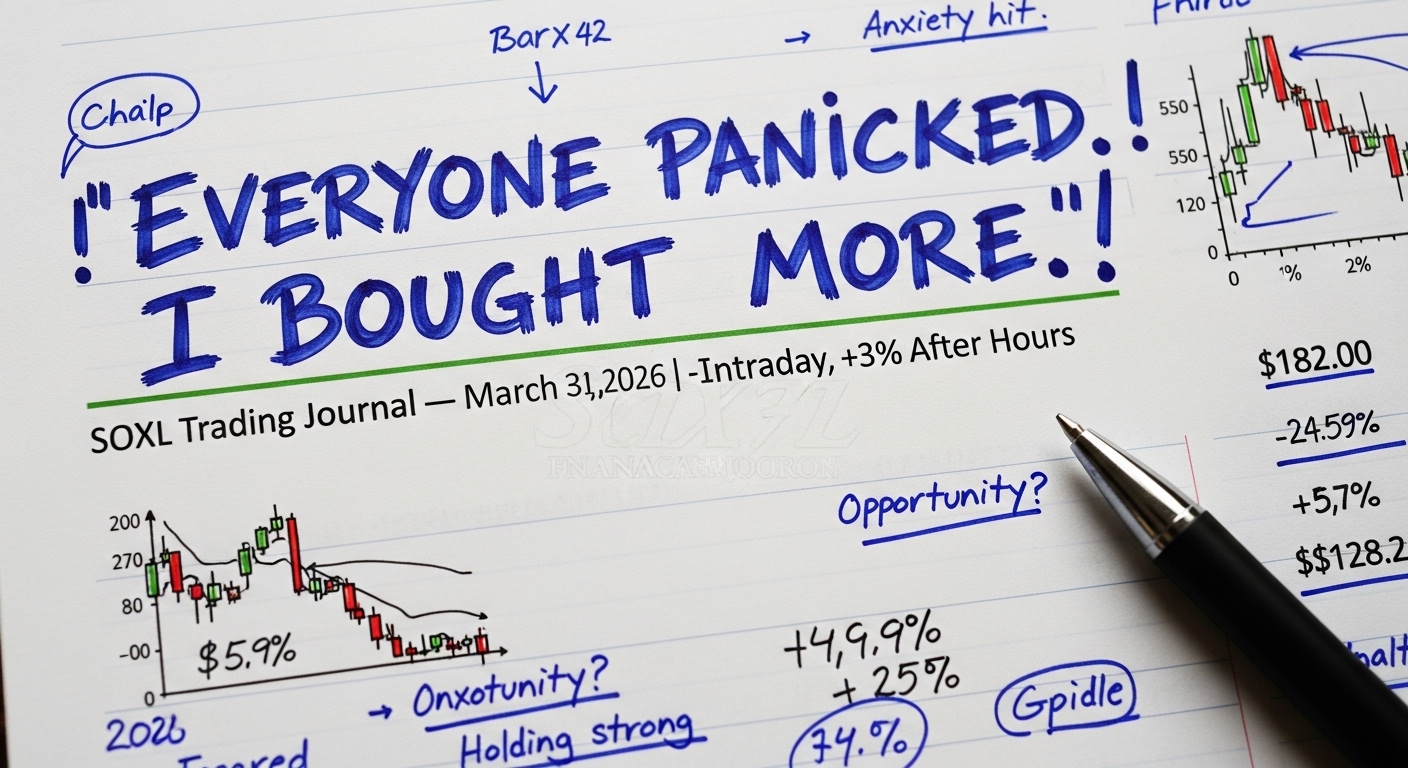
Are you losing sleep over your investment in SOXL (Direxion Daily Semiconductor Bull 3X Shares), the ultimate king of volatility in the U.S. stock market?
While it is true that the semiconductor industry is the heart of AI and data centers, enduring the raw volatility of a 3x leveraged ETF—which can swing 10% in a single day—is no easy feat. Today, I want to dive deep into my Standard Deviation ($\sigma$) Based Buying Principle, a system I have used for over two years to prove consistent returns while maintaining my daily life.

1. Why SOXL? Conviction in the Industry Comes First
Leveraged investing requires faith in the industry before any technical analysis. My reason for sticking with SOXL is simple:
NVIDIA: Dominating the global AI software ecosystem.
Broadcom: Possessing irreplaceable custom chip technology.
Semiconductors are no longer just components; they are the infrastructure supporting the future of humanity. Once you have the conviction that this industry will not fail, the next step is simply a matter of how to buy it cheaply.
2. The Core Buying Principle: The -8.3% Rule for Catching Fire Sales
In 3x leverage, you don’t win by buying when prices rise. You win the average cost battle by mechanically scooping up shares during crashes. I utilize a trading method based on normal distribution statistics.
Key Strategy: Buy when the price drops by -8.3% or more compared to the previous day’s close.
Backtesting shows that when the daily volatility deviates significantly from the mean—specifically hitting the -8.3% mark—buying in those zones yields a win rate of approximately 80%. I call this the process of picking up “fire sales” in the market.
The most critical factor here is capital management. To prepare for prolonged bear markets, I divide my total seed money into at least 20 installments. This creates an “infinite seed” effect, allowing me to respond even if the downturn lasts longer than expected.
3. Real-World Results: $27 Average Cost and the Power of Limit Orders
I have fought the market using this method for over two years. The results?
Current Status: My average cost for SOXL is in the $27 range. Compared to the recent closing price of $52.75, this is a massive profit zone.
Trading Record: When SOXL soared to $72 earlier this year, I took profits on a significant portion of my 1,000 shares. Currently, I hold about 650 shares and am increasing my position again starting from the low $50s.
The true beauty of this method lies in freedom. I don’t need to check charts every night. I simply set a “LOC” (Limit on Close) or a pre-market limit order at the -8.3% mark. If I wake up and the condition was met, the trade is executed. If not, it isn’t. This allows me to focus on my main job while keeping my mental state perfectly intact.
4. Conclusion: Anyone Can Do It, But Not Everyone Will
Even a statistically sound method becomes useless when it hits the wall of human instinct.
Due to the nature of 3x leverage, a price collapse triggers immense psychological pressure. What if you went “all-in” with limited capital? You would likely panic sell at a point far below your average cost.
Ultimately, success in SOXL investing boils down to two things:
Thoroughly divided capital.
Mechanical adherence to the rules.
The moment you mix in your own emotions or opinions, you are likely to be swept away by the waves of volatility. Trust the numbers provided by statistics rather than market noise. If you stick to the -8.3% benchmark and the 20-split buying rule, volatility will become your greatest weapon for wealth creation rather than a crisis.
What are your thoughts? Today is Good Friday and the U.S. markets are closed, but why not set your own buying benchmarks before the market opens next week? While the responsibility of investing lies with the individual, statistics rarely lie.